Showing posts with label ww2. Show all posts

Monday, October 22, 2018

Memories of a Glider Pilot on June 7, 1944 into France


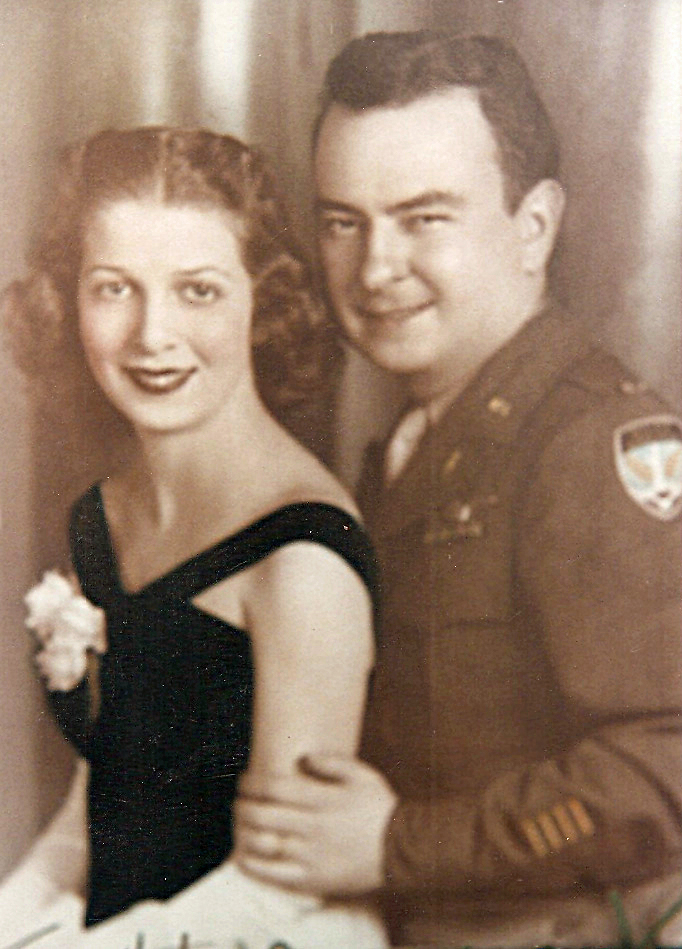
  Flight Officer Charles E. Skidmore, Jr.


Compiled from the memoir of Flight Officer Charles E. Skidmore, Jr., Glider pilot with the 91st Troop Carrier Squadron, 439th Troop Carrier Group
Text Box: The Clear and Present Danger
According to Chuck Skidmore: “When I arrived at our glider ready for the trip to Normandy, the other pilot and I carried our parachutes onto the glider between two rows of airborne infantrymen who were already seated on either side of the glider…About that time, a burly airborne paratrooper lieutenant stuck his head in between us two pilots and said, ‘There's no use in you two fastening those 'chutes. We'd never let you use them anyway.’ I thought that was putting it plainly, so I didn't even bother to drape the straps over my shoulders. You didn't argue with an airborne infantry officer.”
Charles (Chuck) Skidmore, Jr. knew right from his pilot’s briefing for the Invasion of Normandy that a glider pilot’s life could be a short one.  His group briefing was somber right up until the final moment, when he recalled the following: "Sir," asked a glider pilot, "What do we do after we land our gliders?" Chuck relayed that there was a brief period of silence, after which the briefing officer, a non-flying person, admitted, "I don't know. I guess we never really thought of that." Chuck considered that maybe glider pilots were actually considered to be expendable, as he stated that the best answer to the question came from a glider pilot sitting next to him: "Run like hell."
But one of the briefers, a 91st Troop Carrier Squadron's captain named Merriman, showed pilots that certain officers were going to make sure that they had the support they needed to make their destination. Chuck recalled the captain explaining: “Glider pilots will release when the pilot of the C-47 leading the formation starts a gradual turn to the left to return to the coast. If any C-47 pilots cuts his glider off during an invasion without sufficient reason, and there shouldn't be any, he'd better keep on going because if he comes back here, ”I'll be waiting for him" and a courts-martial will be convened immediately.   Chuck added that he never heard of any tow pilot needlessly cutting his glider off during the several invasions that took place on the European continent.

Cutting the cord
The moment of truth, as Chuck Skidmore, his co-pilot, and 13 troops passed through the thunder of anti-aircraft, rushing wind, turbulence and the roar of C-47 radials over the Normandy coastline, is best shared in his own words: “When the other pilot and I cut ourselves free from the tow planes for the Normandy landing, we caught a burst of machine gun fire from the ground which missed my head by about a foot, and then stitched the right wing from end to end. The first bullet - I was flying copilot - just missed my head as we turned our plane to the left, and that’s why it didn't get us. If we'd gone another second farther (or a half second) it would have gotten us both right in the face and we'd have probably all gone down.”
Text Box: The C-47 Balancing Act
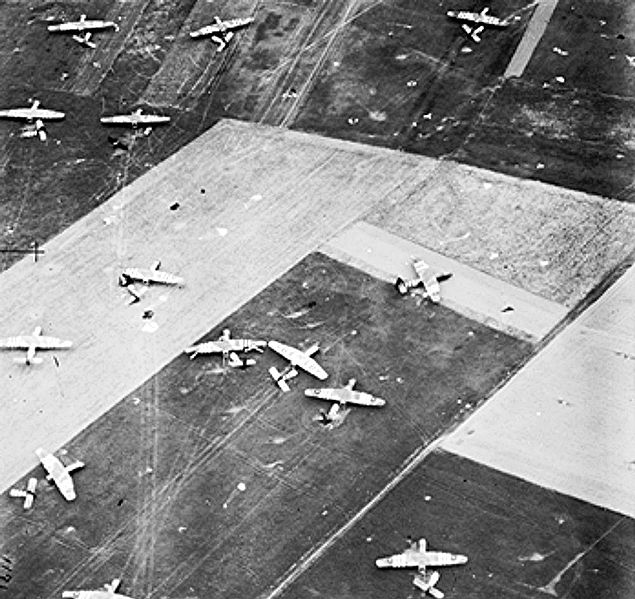
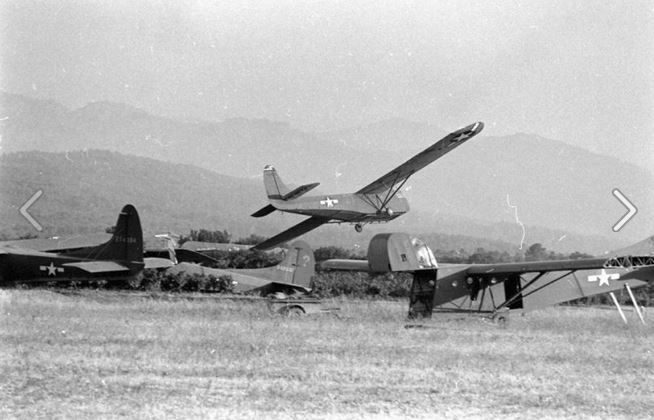
Chuck believed that the workhorses of WW2, the C-47s, were actually underpowered for many of the jobs they were called upon to do, such as pulling the heavily weighted Waco CG-4A combat gliders. 
He shared the story of a C-47 radio crewman who weighed as estimated 300 pounds. (Nobody knew his exact weight.) But he was heavy enough to upset the trim of the C-47 as he walked from front to rear. His pilot, a Captain Anderson, joked to a buddy that he intended to tie the sergeant to his seat at the radio because he didn't want to worry about keeping his plane trimmed straight and level during the assault on D-Day.
Add caption
“Germans had flooded our proposed landing area, so we landed in 3 feet of water,” he continued. “I went out the side of the pilot section by tearing off the canvas and tumbling in the water after first removing my flak vest. One guy didn't have the presence of mind to take off his jacket and fell into a hole where the water was over his head. Luckily for him, the other glider pilot rescued him after a series of frantic dives...Upon landing, we discovered the source of the ground fire that nearly got me. It turned out to be a bunker containing about a dozen conscripted Polish soldiers with one German in charge. After the glider infantrymen from several gliders, including ours, directed a hail of rifle fire at the bunker, the resistance ceased. There was silence in the bunker, and then a single shot. Then there were shouts and laughter, and the Poles emerged with their hands held high and surrendered. They weren't about to fight the Americans so they simply shot the Kraut sergeant.”
The other glider pilot, Del Summers and I then decided to take refuge in a thatched roof farmhouse nearby to get ourselves organized and were surprised to find an American paratrooper in a bed.   He had jumped and had fallen through the thatched roof, he broke his leg.   He simply had crawled into the bed and was waiting the outcome of the war.   We left him there after a awhile, but at the time, he was being aided by a young French lady and didn’t seen to care whether the war continued or not.   I hope he made it back home.
The cost of freedom
On the edge of the field where he landed, Chuck saw a burning C-47. “I could still make out the number on the tail and I knew it had been flown by a good buddy of mine,” he explained. “All aboard were killed, I heard later. I guess I was just lucky to get off so easy. A lot of other guys weren't so lucky.”
By nightfall, Chuck had joined with a group that was looking for a place to bed down for the night. They came upon some GIs digging holes in a small field. “Figuring out that misery loves company, several of us sunk our shovels at the edge of the field,” he stated. But the response was not what he expected:
"Hey, you guys can't dig in here."
"Why?"
"Because we're starting a temporary American cemetery here."
“That did it. We went elsewhere,” Chuck declared.


Returning home
Following his general instructions to get back to the coast and board a ship to England, Chuck spent some time along the way assisting a crew manning a 105 howitzer and later helped a communications outfit. Once at the beach, glider pilots were assigned to load German prisoners on to LCIs (Landing Craft, Infantry). From there, the prisoners were transferred to LSTs (Landing Ship, Tank) to be moved to prison camps in England.
Chuck hitched a ride in an LST to make the return trip across the English Channel. The ship was crammed with 1,200 German prisoners on the main tank deck and only “4 GI cans” to serve as toilets. And just because he made it off the beach, didn’t mean he was out of danger.  Among the 1200 were several
Officers who were pretty well subdued, except for one Nazi storm trooper.  This lieutenant insisted that
Every German prisoner passing by him give the Nazi salute.  One glider pilot finally got tired of this and told a German Corporal to tell the lieutenant without the preliminary Nazi salute that if he, the Nazi, saluted one more time, he , the glider pilot, intended to emphasize his point with a bayonet on the end of his rifle.  That was the end of the saluting.

“The LST was anchored next to an American oil tanker, which later attracted the attention of a German E-torpedo boat,” shared Chuck. “The E-boat fired one torpedo into the tanker, which exploded and sank almost immediately. One sailor, along with a dog who was on top of the mast as lookout, were the sole survivors. The LST crew fished them out of the water. The E-boat's luck ended with the sinking, because at practically the same second as the American ship’s sinking, a British ground attack aircraft swooped down with rockets and machine gun fire and destroyed the German attacker. At the end, it was like watching a newsreel as we observed the whole drama, from the deck of our LST.”
     A couple more incidents on the boat: The German commander of the E-Boat was taken from the water suffering from a wound in his leg.  I helped carry him to the operating table below deck where an American medic got ready to work on the wound.  When the medic indicated that he wanted to cut apart the officer’s prized seal-skin pants, that latter raised all kinds of hell.   It seemed he prized the pants above his well-being.   “If he wants them that bad, let him keep them,” the sympathetic medic said.   So three of us pulled the pants off of the wounded leg.   It must been dreadfully painful, but the Kraut never uttered a sound, and that reminded me of another German who caught his ring on a nail while descending on a ship’s ladder.   The ring tore into his flesh so badly the same medic had to take a surgical saw and remove the ring.   He did it without painkiller, which for some reason the German refused.   Again, the pain must have been terrible, but again no sound.   Most German soldiers had guts, but so did a lot of Americans I knew during the war.   The Glider Pilots made it back to England OK on my ship, and were glad to be there, and I imagine the Germans were glad to be there too.
     This is what I remember from my experiences as a glider pilot on the Invasion of France in June 1944.
Charles E. Skidmore Jr. – US Army Air Corps,  Flight Officer Glider Pilot, 91st TCS, 439th TCG .
                                                                           
Postscript: Life Expectancy of US Army Air Corps Pilots in Combat
During World War II
Bomber Pilots…..
1 Hour, 46 minutes
Fighter Pilots…..
19 Minutes
GLIDER PILOTS…..
17 Seconds


Friday, June 9, 2017

WW II Operation Market Garden Mission


The invasion of Holland mission  begin on 17 September 1944. Flight Officer Chuck Skidmore flew the D Day mission in a CG-4A as pilot, departing from Balderton Airdrome. He said later that the mission was strange from the very beginning and almost humorous.

The day of the mission he was driven out to his glider in a jeep. During his preflight check he
noted that his load was a ¼ ton jeep trailer that was covered with a tarpaulin. Skidmore asked the
loadmaster what was in the trailer and he told him 800 pounds of land mines. He was told not to worry because it would take the weight of a sizeable vehicle to detonate them. Small consolation, Chuck mused. Three gliders troopers of the 82nd Airborne Division were also included in his load.
Chuck waited outside of his glider for some time for his copilot who never appeared. When he
queried the crew chief he smiled and said that the Colonel Young had decided against using two glider pilots on this mission.

 Just prior to his glider being pulled into position for hookup a fourth soldier suddenly showed up at the glider. He wore full combat dress and was carrying a Thompson submachine gun. He climbed over the jeep trailer and sat down in the copilot’s seat. Chuck was surprised to see that it was Warrant Officer Walter F. Domanski, the assistant engineering officer of the 91st TC Squadron. After a brief conversation Chuck learned that he was an unofficial passenger, in essence, a stowaway.

The four hour flight to Holland was boring and tiring, Chuck admitted later that it was a pretty
hairy flight after passing over the Dutch coast. A tow plane just ahead of him went down in flames
after being hit by ground fire. He watched for parachutes but saw none as the plane plummeted to
earth. He felt his heart racing, he said, and he began sweating so profusely that beads of water were
showing inside his watch crystal. Near the end of the 90 mile overland portion of the flight his glider
began to take ground fire from a windmill but fortunately no one was hit. Moments later he received
the green light from his tow plane and released his glider. Turning to the left he quickly spotted his
landing zone. As he circled towards the field below more ground fire was directed at his glider. As he
made his approach he saw another tow plane go down trailing fire. In an effort to evade the enemy fire coming up at him he dove towards the ground, quickly picking up speed. One of the glider troopers 8 aboard sensed that he was exceeding the usual rate of descent and decided to take action. He climbed over the trailer, rapped on Chuck’s steel helmet and shouted, “Slow this S.O.B. down!”
Not knowing quite how to fly the glider and defend himself at the same time, Chuck did the
best he could under the circumstance… he flew the glider. The trooper suddenly shoved him in the
back which caused the glider to begin descending even faster. Fortunately, W/O Domanski came to his rescue. He shoved his Tommy gun into the soldier‘s shoulder and said, “Get back in your seat or I’ll sit you down permanently.” Since the trooper had left his weapon in the back of the glider, and probably because he sensed that discretion was the better part of valor, he beat a hasty retreat to his seat in the back of the CG-4A. Chuck landed the glider on the proper landing zone, but it didn’t fair too well. The giant beets growing on the landing zone pretty much destroyed the bottom of the glider. Chuck helped unload his glider and moments later a jeep arrived to tow the trailer.

Within several days he was back in France. In October, November and December 1944, Chuck flew resupply missions to Holland as copilot aboard the squadron’s C-47s. On 4 December 1944, he was awarded an oak leaf cluster to the Air Medal and the Distinguished Unit Badge for his participation in Operation “Market.” He was also awarded the orange lanyard by the Dutch, and belatedly was also awarded the Willemsorde, the Netherlands highest award.

Flight Officer Charles E. Skidmore Jr. 91st Sqdn 439th TCG

World War II Glider Pilot D-Day Account

In the early morning hours of June 7, 1944 my father Army Air Corps Glider Pilot, Charles E. Skidmore Jr.was landing his glider in a flooded field just outside
of the town of Sainte Mele Eglise, France in three feet of water. This is his account of the mission:

As the glider settled on the water, I removed my flak vest, tore a large piece of fabric off the side of the cockpit and rolled out into the water. The other pilot and I waded to dry land and headed for the nearest hedgerow for protection.

Once on the ground, so to speak, the glider infantrymen quickly located the source of nearby ground fire.It turned out to be a bunker containing about a dozen conscripted Polish soldiers with a German sergeant incharge. After the glider troopers from several gliders, including me and my thompson machine gun, directed a hail of rifle and bazooka fire at the bunker the resistance ceased. Then a single shot was heard inside the bunker, followed by laughter. Soon the Poles emerged with their hands held high in surrender. They weren’t about to fight the Americans. They simply shot the German sergeant.

Myself, and some other pilots took refuge in a thatched roof farm house. We were surprised to find an American paratrooper with a broken leg on one of the beds. He had jumped the night before and had fractured his leg when he fell though the thatched roof of the farm house. A young French girl was caring for him, so he just lay there waiting for the war to come to him. I wondered afterwards if he made it back home okay.

By nightfall, a group of us began looking for a safe place to catch a few winks. We came upon several other Americans busily digging holes in a small field, so we likewise began digging in the same area. “Hey, you guys can’t dig there,” said one of the Americans. “Why,” we asked. “Because we’re starting a temporary American cemetery here,” was the reply. They were burying several dead American paratroopers. That did it. We went elsewhere.

 For the next 24 hours we spent some time with a 105mm artillery crew, providing perimeter guard,
and then joined a communications outfit.

There was considerable confusion for the next two days since there were no distinct battle lines, and the war consisted of a number of small skirmishes between Americans and Germans. We learned that the troops had moved off the beach and the Americans appeared to be winning their skirmishes. I and most of the surviving glider pilots began to assemble at the 101st command post. On the third day we made the 3 mile trek to Utah Beach where the beach master assigned them the job of guarding German POWs (Prisoners-of-War). Later that day, glider pilots and POWs were loaded aboard an LCI (Landing Craft Infantry) and then onto an LST (Landing Ship Tank) for the trip back to England.

The LST was a mess. We had 1,200 German prisoners on the main tank deck and only 4 GI cans to serve as toilets. Among the 1,200 were several officers who were pretty subdued, except for a Nazi Stormtrooper. This lieutenant insisted that every German prisoner passing by him give him the Nazi salute. One of the glider pilots finally tired of this and told the corporal to tell the lieutenant-without the preliminary Nazi salute- that if he, the Nazi, saluted one time, he, the glider pilot, intended to emphasize his point with a bayonet on the end of his rifle. That was the end of the saluting.

A little excitement occurred while we were on the LST. It was anchored next to an American oil tanker that subsequently attracted the attention of a German E-boat (similar to an American PT boat). The E-boat launched a torpedo that struck the oil tanker below the water line and it exploded. There was only one survivor, a man and his dog. Moments later a British ground attack aircraft fired on and sank the E-boat. I thought it was much like watching a newsreel as the incident unfold before your eyes.Miraculously, the German commander of the E-boat was rescued by crewmen from the LST I was on. Hehad a severe leg wound. I helped carry him to the operating table below deck where an American medic tended to the wound. When the medic indicated that he wanted to cut apart the officer’s sealskin trousers, the latter exploded with anger. The medic retorted, “If he wants them all that bad, let him keep them.” So I and the medic, with the help of the German removed his trousers. It must have been dreadfully painful, but the German never uttered a word. He sat stoically as the medic tended to his wound.

One of our Kraut prisoners was an overaged German Major who had been stationed in Normandy to
recover from wounds received earlier on the Russian front. When we passed out the dreaded K-rations for a midnight meal, the Major refused to eat. We ask an English speaking German corporal what the Majors complaint was, and we were informed that the Major was used to good meat and dairy products of Normandy and he didn’t appreciate our canned products. One of the other glider pilots told the corporal to inform the Major that it was Krations or nothing, and of he didn’t eat that we might stuff them right down his throat, cans and all.

In another instance while on the LST a German POW caught his ring on a nail while descending the
ship’s ladder. The ring tore into the flesh so badly that the same medic had to take a surgical saw and remove the ring. He did it without a painkiller, which for some reason the German refused. Once again, the pain must have been terrible, but there was not a peep out of the prisoner. The Germans were obviously well disciplined when it came to pain, I thought to myself. When the LST landed in England the prisoners were turned over to the British military.

I got fairly well acquainted with the German corporal that was my interpreter, helping me for 2 days. I discovered he was the son of a German father and British mother. At the outbreak of war in 1939 when he was still a youngster, the family was visiting and got stuck in Germany. He was eventually drafted into the German army. I believed his story enough to give him a note of appreciation to take along with him to his eventual prison camp in England. I hope he was able to regain his English citizenship, because that’s what he wanted.

As I record this on April 4, 1988, this is what I remember as a Glider Pilot on the invasion of France in June 1944. Our instructions were to get back to the coast as best we could and get on a ship for return to England.

We landed a mile and half from Sainte Mele Eglise, the scene for the movie ”The Longest Day” wherein actor Red Buttons witnessed a Day-long battle while swinging in his parachute from a church roof.

I saw a burning C-47 aircraft on the edge of the field where I landed. I could still make out the number on the tail and I knew it had been flown by a good buddy of mine. All aboard were killed, I later heard.

As I stepped off the ship I gave thanks that I had survived my first combat mission against the enemy.
I guess I was just lucky to get off so easy, a lot of other guys weren’t so lucky.

Flight Officer Charles E. Skidmore Jr. - 91st sqdn 439th TCG